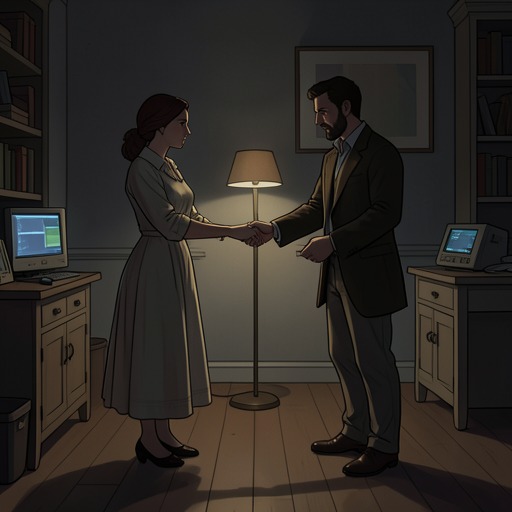
Ella confided in her father about the past and agreed to arrange her own independent plan
Cinder & EllaElla and her father’s candid conversation in family therapy turns a history of abandonment into a negotiation over truth, trust, and independence. He reveals that their marriage began under pressure and that his resentment contributed to years of distance; Ella answers not by asking to be absorbed into his household, but by asking to be free to leave it. The session ends with a practical compromise: her recovery comes first, and when she is ready to leave the clinic, they will plan her next steps together without assuming that she must remain under his control.
The supervised setting and its purpose
About a week after Ella’s admission to the clinic, Dr. Parish allows her father and Jennifer to visit, on the condition that their time together be supervised. The visit is effectively family therapy, following Dr. Parish’s recommendation that Ella and her father attend sessions regularly. Ella is startled that her father agrees without hesitation. His willingness to participate marks a change from the distance she has known, but it does not make reconciliation automatic: the session gives them a structured place to address what has been left unexplained.
Her father says he loves her and apologizes for having let her down. Ella does not treat the apology as sufficient. What hurts most, she tells him, is not understanding why he left her. Dr. Parish reinforces the need for an honest answer: without one, Ella cannot forgive him or move beyond the past, and they cannot build a genuine relationship. His explanation therefore becomes the central work of the visit—not a general expression of remorse, but an account of the family history that has shaped their present conflict.
The history behind the estrangement
Ella’s father says he should never have married her mother. When they met, he was in his final year at a prestigious law school, consumed by study and the prospect of a demanding job. Their dates were enjoyable but casual; he says they were never in love and were not a committed couple. He was shocked when Ella’s mother told him she was pregnant. He did not want a child at that point and asked her to have an abortion. His admission forces Ella to confront the possibility that her birth had not been wanted by him.
Ella’s mother refused to end the pregnancy and asked him to marry her. Her religious parents threatened to disinherit her if the couple did not marry. Because she was close to them and would otherwise have faced raising a baby alone, Ella’s father says he accepted responsibility and married her, although he did not want the marriage. In Ella’s understanding, she was born of an unwanted pregnancy followed by a marriage neither parent had entered out of love. Her father acknowledges that he blamed Ella for his unhappiness, then corrects himself: the child was not responsible; the adults were. The correction names the harm without undoing it, and his apology arrives only after Ella has had to hear the painful account behind it.
He describes a marriage in which both parents held on to resentment. Ella’s mother repeatedly reminded him that he had wanted an abortion and, in his view, made it difficult for him to become close to their daughter. He says she deliberately drove a wedge between them. He also recalls that she raised Ella as Chilean, taught her a language he did not speak, and largely brought her up with her own parents, while Ella had little contact with his family. His family lived on the West Coast; during the marriage, he says, they visited them only twice, and Ella had not seen her paternal grandparents since she was three. He then tells her that his parents are still alive and that she also has an aunt, an uncle, and three cousins. The disclosure expands the family story beyond the absence Ella has known, while making clear that his account is also an account of how he understood—and failed to challenge—the separation.
Ella names what she needs
After explaining that life in Boston had become painful and that Jennifer and her daughters had made him feel needed and loved, Ella’s father asks how he can make amends. Ella’s answer is direct: he has to let her go. She asks Dr. Parish to end his guardianship when she is ready to leave the clinic. Although she is an adult, she says, she cannot make her own decisions; decisions are instead made by someone who was nearly a stranger to her. She recognizes that he is trying to do his best, but argues that what suits him and his family may not suit her. What she needs is people who trust her.
Ella distinguishes a relationship with her father from compulsory membership in his household. She tells him that trying to recover is harder around his family because she feels unable to breathe in his home: she feels like an outsider and an intruder, and believes she brings trouble to everyone. She asks whether Jennifer and Anastasia want her there, not only whether her father does. Jennifer admits that she had not expected the situation and that it has been difficult for her daughters; she apologizes for making Ella feel unwelcome. Ella accepts that no one intended for matters to unfold this way, but does not take that understanding as a reason to stay.
Instead, she describes a route toward living apart. Vivian has offered her a place to stay until she finds an apartment of her own, and Juliette has suggested that they might live together the following year, when Juliette is allowed to move out for college. Ella offers her father a different basis for rebuilding their relationship: they can get to know one another, share meals or go to the cinema, and talk. But he must not keep her confined or force her to become part of a family she does not experience as her own. Her boundary is not a rejection of reconciliation; it is a condition for making one possible.
A compromise, not a completed reconciliation
Ella’s father initially struggles with the proposal, but she confirms that moving out is what she needs and what Anastasia needs, too. Ella holds her breath until she sees that he has made a decision. He agrees that while she remains in the clinic, they should concentrate on her getting better. When she is ready to be discharged, they will work out a plan. He asks whether he may help with that planning, explaining that he would feel more comfortable if he could have some part in her decision-making process.
Ella accepts this as a workable compromise, and her smile reaches her eyes. The agreement does not immediately end her father’s legal authority, settle the family’s conflicts, or erase the effects of the history he has disclosed. It does, however, replace an assumption of permanent control with a future conversation about her discharge and living arrangements. The scene’s reconciliation is therefore deliberately bounded: Ella is willing to build a relationship with her father, but insists that trust requires room to make her own life.
Significance within the family conflict
The conversation brings together two forms of disclosure. Ella’s father makes explicit the origins of his absence and the resentment he once directed toward her; Ella makes explicit the cost of being treated as a dependent within a household where she feels unwanted. Neither confession simplifies the family into a single guilty party or resolves the harm through a quick apology. The revelation helps explain the past, while Ella’s account of the present prevents that explanation from becoming an excuse for continued control.
The supervised session also frames care as a question of who gets to define what is best for Ella. Dr. Parish has helped establish the setting and urges honesty, but Ella herself states the terms she needs: recovery, trust, and a say in where she will live. Her father’s final agreement matters because it acknowledges those terms and makes his participation in her future planning something she may accept rather than something imposed on her. The scene closes not with complete family unity, but with a negotiated possibility of connection that leaves Ella’s independence at its center.